
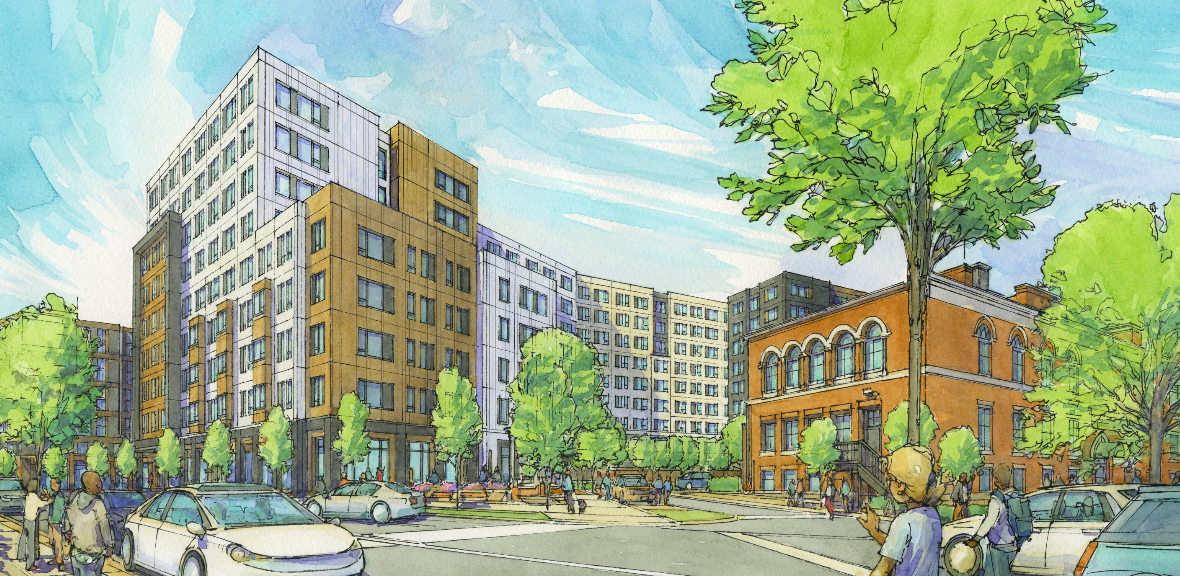
If you have ever driven through Bunker Hill in Boston, you may have noticed the rows and rows of brick, block-like buildings crowded together. These buildings were built before the end of WWII – which may not be unusual for Boston – but without proper maintenance they are completely falling apart, and may resemble prisons more than homes. But instead of responding to the housing crisis with even bigger concrete blocks, contributing even more to the 40% of energy-related CO2 emissions coming from buildings, the Boston Housing Authority and its partners at Leggat McCall, Stantec, RDH, and Suffolk are trying something different. Now, the first of 15 buildings in the largest public housing project in New England is complete. This multifamily affordable housing building has been carefully constructed to fulfill Passive House standards and even lay down a path for net-zero emissions in the near future.
Project Summary
The goal of this project was to replace an 85-year old array of low-density housing with 15 new, energy-efficient buildings and more than double the residential capacity. The new buildings will include both affordable and mixed affordable/market-rate housing to foster a new, diverse, and interconnected community on Bunker Hill, while also being sustainable and reducing energy costs. The hope, in order to ensure quick delivery to the market, is to complete these buildings in half the time of another project of this scale, and for 20% less money. This means optimizing productivity, which the team plans to increase throughout each of their 10 phases.
“We are very excited to roll everything that we learned from building M, which was immense, into building F […] It’s very rare, in our world, to have 15 times to iterate on something in a row”
–Nick Nigro, Senior Project Manager, Leggat McCall Properties
Extreme care and many components went into the making of this building a Passive House. In order to ensure an effective air-tight envelope encircling the building, the team used pre-fabricated exterior walls and flooring. The walls arrived finished with windows, insulation, AVB [Air and Vapor Barrier, to protect from moisture and seal the joints (designed breaks to manage stress from temperature or shrinking)] and cladding already installed, eliminating the need for exterior scaffolding or a tower crane foundation. To exclude columns and beams from the finished product, these wall panels were structured to be loadbearing, so that they could support the weight of the full ceiling. Such ceilings were large panels too, and made completely of CLT (Cross-Laminated Timber). Some panels were up to 8ft x 64 ft, at 8 inches thick. These acted as both the ceiling and floor of each unit. Because they were all made off-site, the crew could eventually lay down 7,000 SF of flooring in just one day. About 21,000 SF of exterior walls could be erected in just six days. At those rates, each floor took only 2 weeks to complete, and all with only 6 on-site carpenters!
For heating and cooling, efficient heat pumps were installed in every unit, with branching ducts to each room. In addition to temperature, the continuous filtered air and the biophilic exposed wood creates a more healthy living environment.
Notable Project Features
- Offsite manufacturing of fully-finished wall and floor panels
- Cross-Laminated Timber used to simplify flooring and reduce floor-to-floor height
- Large wall panels lifted directly onto site
- All meeting Passive House standards
- Loadbearing walls instead of steel columns
- 40% reduction in embodied carbon
Challenges & Lessons
The biggest challenge the team faced was finding someone to produce exterior walls that would be loadbearing; they could find people to do finished and insulated walls that weren’t, but they wanted to avoid using steel structural support like columns and beams. Although they overcame this challenge, they are planning to try CLT wall panels on the 3rd building, which will be a part of phase 2. This could cut down another 35-50% of embodied carbon from the light-gauge steel bearing walls, to raise the total to 75-90% reduction. For now, we look forward to the progression of the next building – building F – which will be 265 units of mixed income housing in 9 stories, including a parking podium.
Further Opportunities for Efficiency
- Different hot water systems:
- More localized natural gas hot water to reduce heat loss from water traveling through long pipes
- Low-carbon electric or renewables (potential for net-zero)
- Wastewater heat recovery
- Getting rid of emergency diesel generators, possibility of battery storage
- Prefabricated kitchens & baths to improve construction time and costs
The members of this large-scale public housing project are dedicated to experimenting with prefabricated construction and replicable designs to pave a new path of affordable sustainability in building. To see what fits these needs best, they are exploring a unique combination of offsite manufacturing, CLT flooring, loadbearing walls, and Passive House techniques. Each component is deliberate in its multifunctionality, ticking off key things like structural integrity, affordability, sustainability, energy efficiency, health factors, and construction time. Because of this, the finished product will be a great replacement for the old housing developments, both meeting housing demands and pushing for a more sustainable Boston.
Takeaways
- Manufacturing: Offsite pre-fabrication has the potential to reduce onsite construction time and cost, and produce a more airtight wall assembly
- Mass Timber: Cross-Laminated Timber panels reduced construction time, minimized floor-to-floor height, reduced building weight, and created a more aesthetically pleasing interior finish
- Sustainable Materials: Embodied carbon was reduced by 40% by replacing concrete with CLT floors and structural steel with light-gauge steel bearing walls
- Experimental Building: The team’s desire to learn and their application of lessons learned from one building to the next will allow for a faster, cheaper, and more sustainable progression of the project
Learn More
This article was written by Riley Dill, the inaugural Summer Intern at Passive House Massachusetts. Riley is currently a student in the Boston area interested in sustainability and the built environment.
Leave a Reply